How Does a Heat Pump Work? A Plain-English Guide for UK Homes
Around three quarters of the heat a heat pump delivers doesn't come from the grid — it comes from the air outside your house, free of charge. The electricity only powers the machinery that moves that warmth indoors and concentrates it to a useful temperature. That's the whole trick, and it's why a heat pump can be roughly three times as efficient as even the best gas boiler. Here's how it actually works.
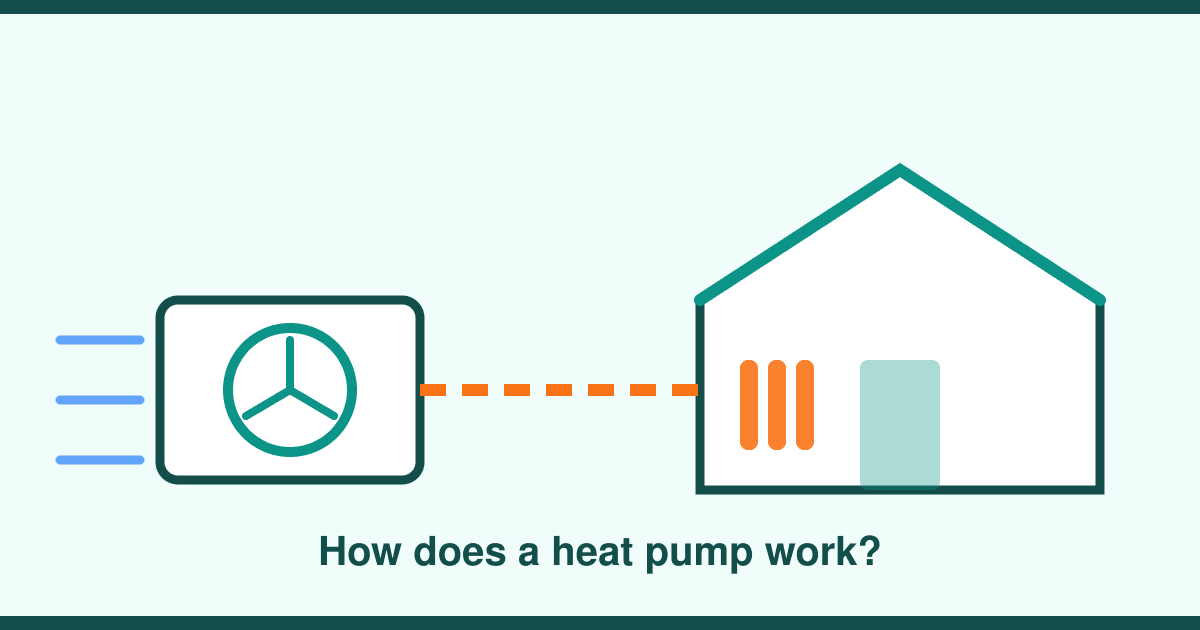
In short: A heat pump is a refrigerator running in reverse. A refrigerant absorbs warmth from the outside air, a compressor squeezes it until it's hot, and that heat goes into your radiators and hot water. For every 1 kWh of electricity, you typically get around 3 kWh of heat.
The four-step cycle — a fridge in reverse
Your fridge pulls heat out of your food and dumps it into the kitchen through the grille at the back. An air source heat pump does exactly the same thing, just pointed the other way: it pulls heat out of the outdoor air and dumps it into your home. The refrigerant inside makes this possible because it boils at extremely low temperatures:
- Evaporate: The liquid refrigerant flows through the outdoor unit, absorbs warmth from the air — yes, even cold winter air holds usable heat energy — and turns into a gas.
- Compress: An electric compressor squeezes the gas. Raising the pressure raises the temperature, so the refrigerant becomes properly hot. This is where nearly all the electricity is used.
- Release: In a heat exchanger, the hot gas passes its energy into your heating water — for radiators, underfloor heating and the hot water cylinder — and condenses back into a liquid.
- Expand: An expansion valve drops the pressure, the refrigerant cools right down, and the cycle starts again.
What SCOP actually tells you
Heat pump efficiency is measured by the Seasonal Coefficient of Performance (SCOP) — the heat delivered across a whole year divided by the electricity used. A SCOP of 3.0 means 3 kWh of heat per 1 kWh of electricity: in boiler terms, 300% efficiency, where a modern gas boiler manages around 90%.
| System | Typical efficiency |
|---|---|
| Modern gas boiler | around 90% |
| Air source heat pump (UK average) | around 300% (SCOP ≈ 3.0) |
| Well-designed modern installation | up to 350–400% (SCOP 3.5–4) |
Modern units are rated between 3 and 4; real-world UK figures typically land between 2.5 and 3.5 — and the gap between a mediocre and an excellent result comes down mostly to system design, not the box on the wall.
The design secret: flow temperature
The less a heat pump has to lift the temperature, the more efficiently it runs — as a rule of thumb, every 10°C reduction in flow temperature improves efficiency by around 10–15%. That's why heat pump systems run radiators at 35–50°C rather than a boiler's 60–70°C, and why installers may recommend a few larger radiators or underfloor heating.
Good systems also use weather compensation: on a mild 10°C day the pump might send 35°C water to your radiators, and only ramp up to around 50°C when it's -3°C outside — always doing the minimum work needed. This is exactly the sort of detail a proper heat loss survey gets right, and a big reason to use an MCS-certified installer.
Does it really work in a British winter?
Yes. Heat pumps keep extracting warmth from air well below freezing — the physics doesn't stop at 0°C, the unit simply works a little harder. In frosty weather you'll occasionally see the outdoor unit pause and steam gently: that's a short defrost cycle clearing ice from the heat exchanger, and it's completely normal. Scandinavian countries, rather colder than the UK, have some of the highest heat pump adoption rates in Europe.
Thinking about costs? Installation typically runs into five figures before support, but the £7,500 Boiler Upgrade Scheme grant takes a large bite out of that — and our installation cost guide breaks down what's left.
The bottom line
A heat pump doesn't create heat — it moves it, which is why it beats any boiler on efficiency. Whether it performs brilliantly or merely adequately in your home comes down to design: flow temperatures, radiator sizing and a proper survey. Before anything else, check the planning rules, then find vetted heat pump installers in your area here.
Frequently asked questions
Like a fridge in reverse: a refrigerant absorbs warmth from the outside air, an electric compressor squeezes it until it is hot, and that heat is transferred to your radiators and hot water cylinder. For every 1 kWh of electricity used, a typical system delivers around 3 kWh of heat.
Yes. Even sub-zero air contains usable heat energy, so heat pumps keep working well below freezing — they just work a little harder, and occasionally run a short defrost cycle to clear ice from the outdoor unit. Countries far colder than the UK, like Norway and Sweden, are among the heaviest heat pump users in Europe.
Modern air source heat pumps are rated with a SCOP between 3 and 4 — meaning 300–400% efficiency. Real-world UK performance typically lands between 2.5 and 3.5, and system design (especially low flow temperatures and correctly sized radiators) matters more than the brand of the unit.
Often some, not all. Heat pumps run radiators at 35–50°C rather than a boiler’s 60–70°C, so a few radiators may need upsizing to deliver the same warmth at the lower temperature. A proper heat loss survey by an MCS-certified installer will identify exactly which ones.